Loading blog details...
Related Blogs
Loading blog details...
Loading blog details...
Related Blogs
Loading blog details...
Confused between AI agents and chatbots? Compare their features, costs, and use cases to find the right fit for your business needs and budget.

Businesses are moving fast. Customers expect instant responses, personalized experiences, and round-the-clock support. To meet these expectations, many companies are turning to AI-powered tools, and two names keep coming up in the conversation: chatbots and AI agents.
But here is the thing. A lot of business owners use these terms interchangeably, and that is a mistake. Chatbots and AI agents are fundamentally different technologies.
In this blog, we will break down exactly what chatbots and AI agents are, how they differ, and most importantly, which one your business actually needs.
A chatbot is a software program designed to simulate conversation with users. It typically follows a pre-defined set of rules or scripts to respond to user queries. When a customer types a question, the chatbot matches it to a predefined response and delivers an answer.
Most chatbots work in one of two ways:
Rule-based chatbots follow a decision-tree structure. They can only respond to specific inputs they have been programmed to handle. If a user asks something outside that range, the bot either fails or redirects.
AI-powered chatbots use Natural Language Processing (NLP) to understand and respond to a wider variety of inputs. They are smarter than rule-based bots but still operate within a fairly limited scope.
Chatbots are great for handling repetitive, straightforward tasks like answering FAQs, collecting basic information, or routing customers to the right department.
An AI agent goes beyond simply answering questions. It can understand goals, make decisions, and take action to complete tasks.
It perceives its environment, makes decisions, takes actions, and works toward achieving a specific goal, often without human involvement.
Think of an AI agent as a digital employee. It can browse the web, send emails, manage files, execute code, interact with third-party tools, and complete multi-step tasks autonomously. AI agents use large language models (LLMs) like GPT-4 as their reasoning engine and can adapt their behavior based on context.
For example, an AI agent in a sales team could research a prospect, draft a personalized email, schedule a meeting, and log the interaction in a CRM, all on its own.
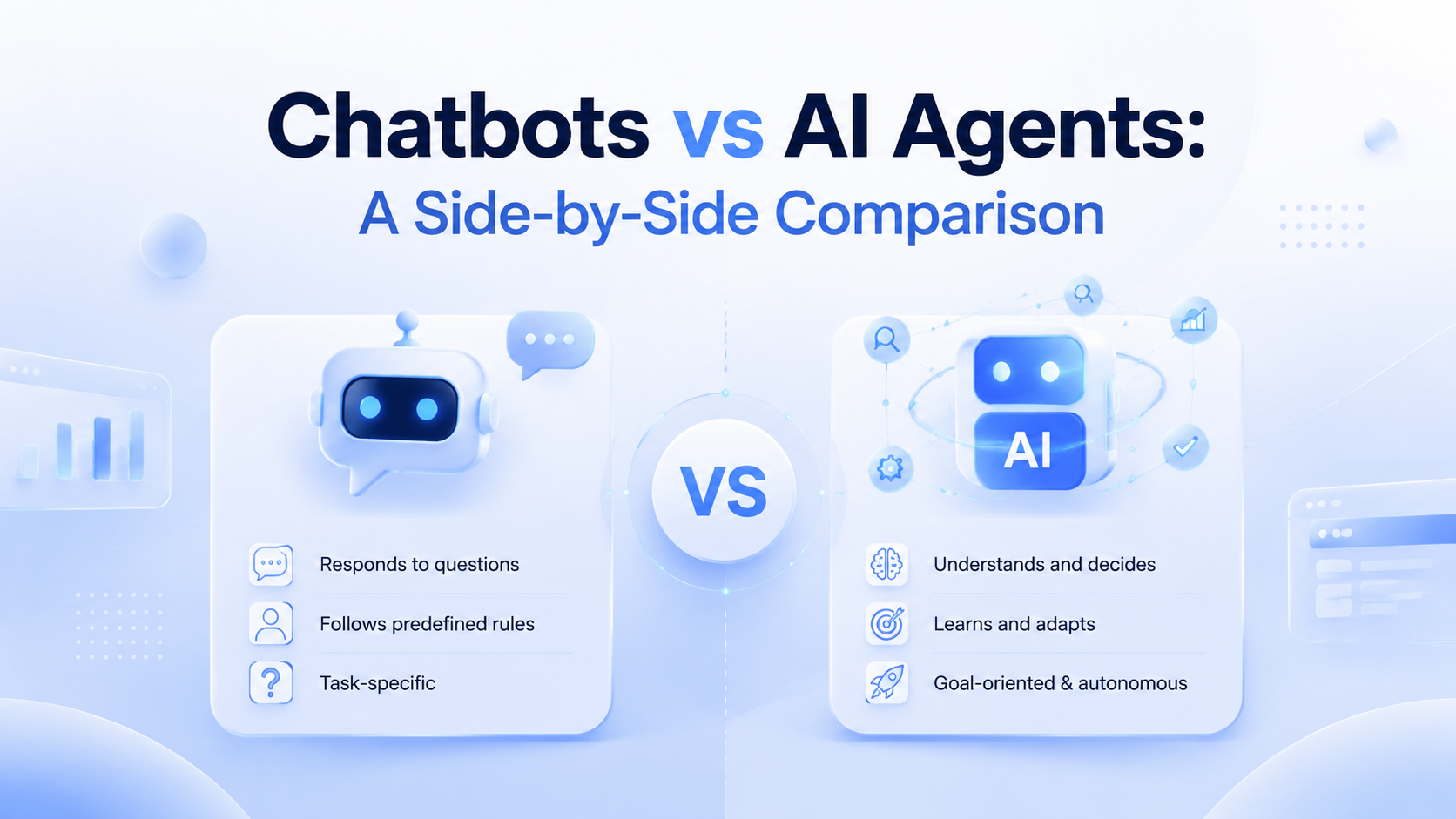
Here is a quick overview to help you understand the core differences:
| Feature | Chatbot | AI Agent |
| Primary function | Conversation and Q&A | Task execution and decision-making |
| Autonomy level | Low to moderate | High |
| Learning ability | Limited (requires retraining) | Continuous learning and adaptation |
| Complexity of tasks | Simple, repetitive tasks | Complex, multi-step tasks |
| Integration capability | Basic (limited APIs) | Advanced (multiple tools and systems) |
| Human intervention needed | Frequently | Rarely |
| Setup complexity | Low to medium | Medium to high |
| Cost | Generally lower | Generally higher |
| Best use case | Customer support, FAQs | Workflow automation, research, operations |
A chatbot waits for a user to start a conversation and then responds. It is reactive. An AI agent, on the other hand, can initiate tasks, make decisions mid-task, and change its approach based on what it encounters. It is proactive.
Imagine asking your tool to "book the cheapest flight to New York next Friday." A chatbot might ask you a series of questions and then give you a link to a booking site. An AI agent would actually go find the flights, compare prices, and complete the booking for you.
Most chatbots have short-term memory. Once a conversation ends, the context is gone. AI agents can maintain long-term memory, meaning they remember past interactions, preferences, and task histories. This makes them far more personalized and effective over time.
Chatbots are generally limited to the platform they live on. An AI agent can connect to external tools like Google Calendar, Slack, Salesforce, databases, and even write and run code. This makes AI agents incredibly powerful for automating complex workflows.
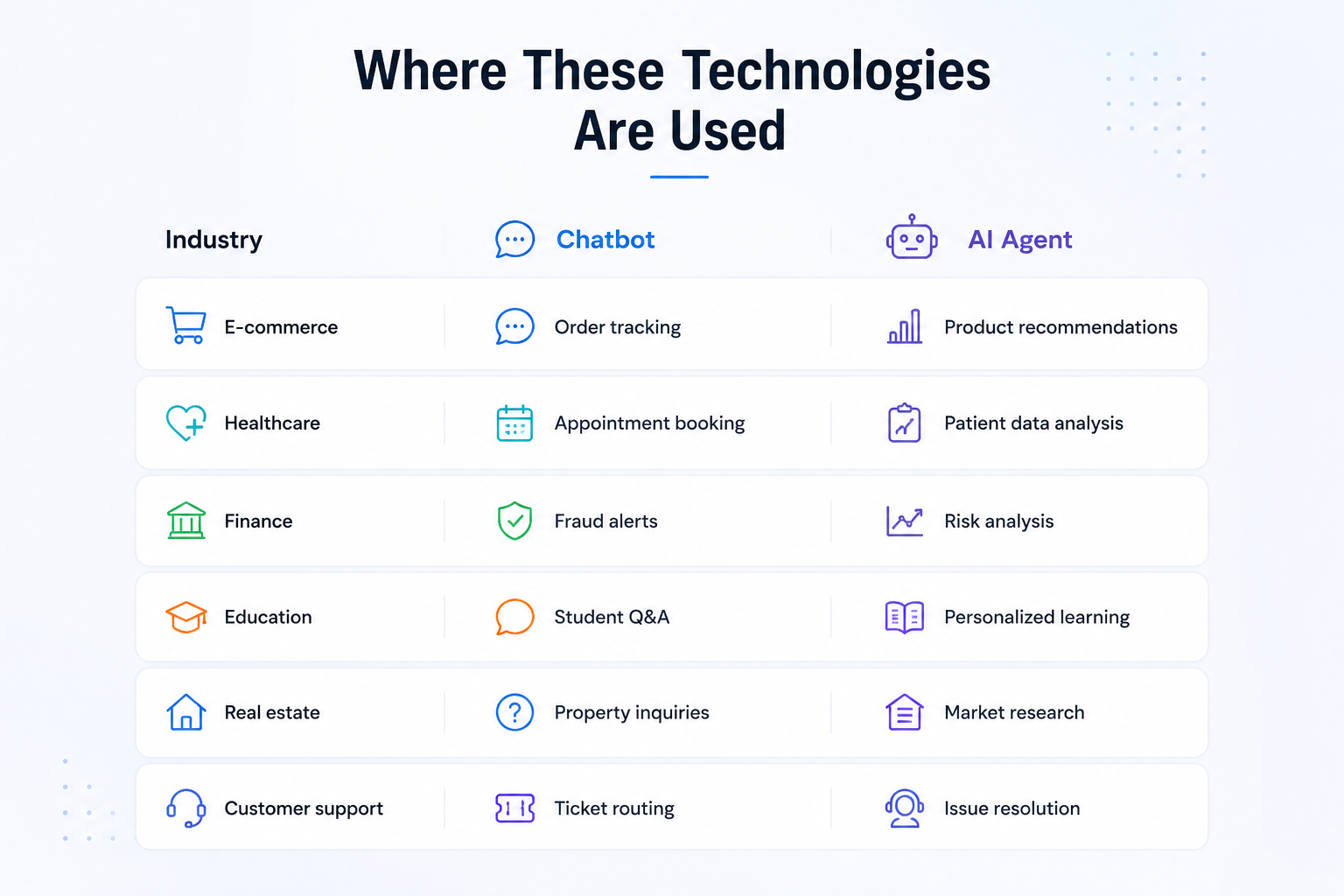
Both chatbots and AI agents are being used across industries, but in different ways. Here is a breakdown:
| Industry | Chatbot Use Case | AI Agent Use Case |
| E-commerce | Order tracking, FAQ responses | Personalized product recommendations, inventory management |
| Healthcare | Appointment booking, symptom checkers | Patient data analysis, follow-up scheduling |
| Finance | Account inquiries, fraud alerts | Automated trading, risk analysis |
| Education | Student Q&A, course navigation | Personalized learning paths, content generation |
| Real estate | Property inquiries, lead capture | Market research, automated listing updates |
| Customer support | Ticket routing, basic troubleshooting | Complex issue resolution, proactive outreach |
Chatbots are the right choice when your needs are clear, repetitive, and conversational. Here are some strong signals that a chatbot will serve your business well:
You receive high volumes of repetitive questions. If your support team spends most of its time answering the same ten questions over and over, a chatbot can handle those instantly, 24/7, without additional staffing costs.
You want to capture leads. Chatbots are highly effective at collecting visitor information, qualifying prospects, and routing them to the right sales rep. Many businesses have seen lead conversion rates improve significantly after deploying a chatbot on their website.
You have a limited budget. Chatbots are far more affordable to build and maintain than AI agents. For small and medium businesses, they offer an excellent return on investment without the technical overhead.
Your workflows are simple. If the tasks you want to automate follow a predictable path, a chatbot is perfectly capable of handling them.
AI agents are the right choice when you need something that can think, plan, and act with minimal human supervision. Consider an AI agent if:
You need to automate complex, multi-step workflows. If a task requires gathering data from multiple sources, making decisions, and executing actions across different tools, only an AI agent has the capability to handle that end-to-end.
You want to scale operations without scaling headcount. AI agents can handle tasks that would otherwise require a full-time employee, making them ideal for growing businesses that want to stay lean.
Your team deals with unstructured data. AI agents can read documents, analyze reports, extract insights, and summarize information in ways that traditional chatbots simply cannot.
Personalization is a priority. Because AI agents remember context and learn over time, they can offer a much more tailored experience for users and customers.
Budget is always a consideration. Here is a general idea of what businesses can expect:
Chatbots can range from free (using basic platforms) to a few hundred dollars per month for more advanced solutions with NLP capabilities. Custom-built chatbots vary depending on complexity and the development team involved.
AI agents, given their sophistication, typically involve higher development costs and ongoing infrastructure expenses. However, the ROI can be significant when they are replacing time-intensive manual tasks.
For most small and medium businesses, starting with a well-built chatbot is the smarter financial decision. It delivers real results without the complexity or cost of a full AI agent deployment.
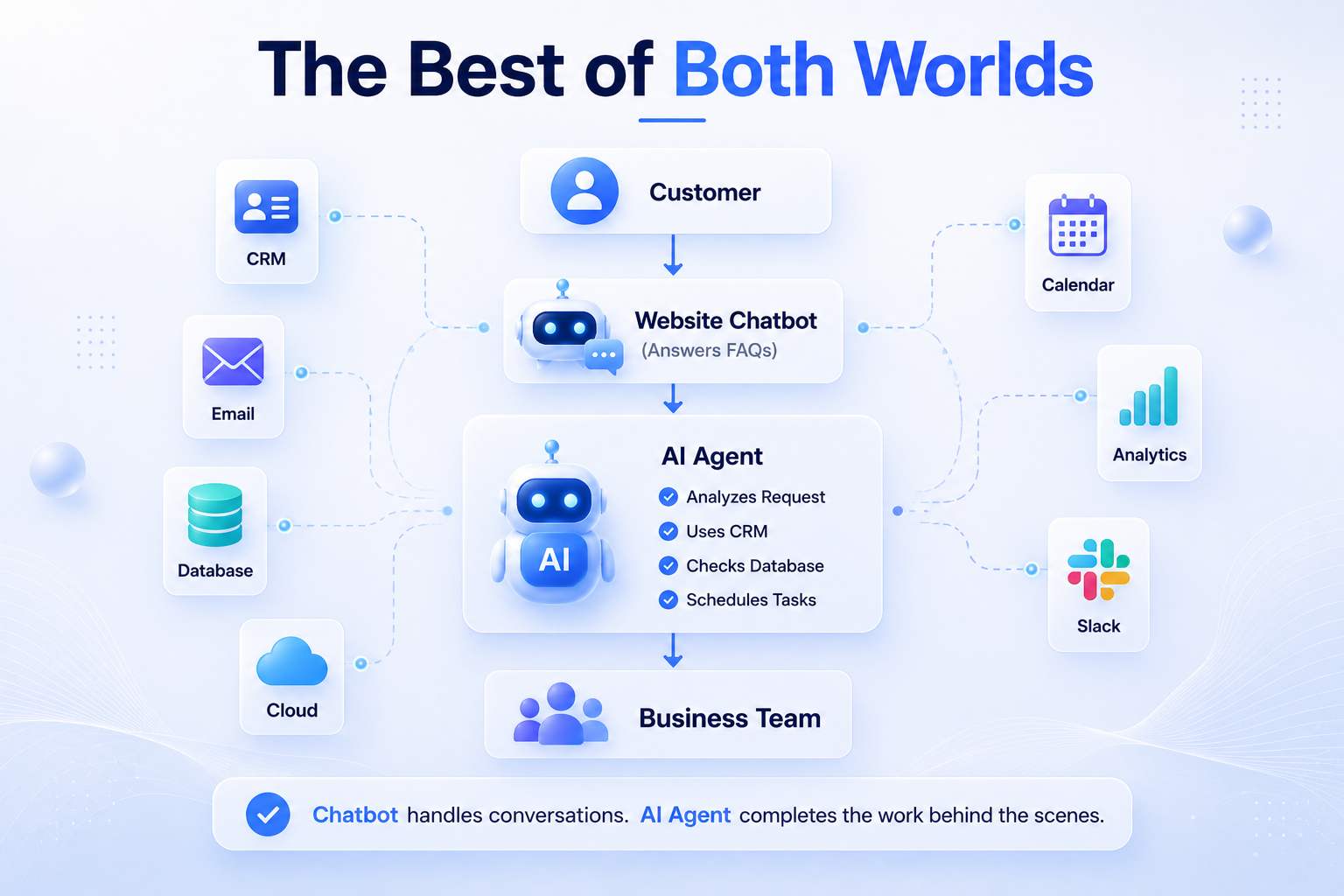
Absolutely. In fact, many forward-thinking businesses are building hybrid systems where a chatbot handles front-line customer interactions and an AI agent works in the background to process data, update records, and trigger complex workflows.
For example, a chatbot on your website might collect a customer's complaint and basic details. An AI agent in the background then classifies the issue, retrieves the customer's history, generates a proposed resolution, and notifies the right team member, all before a human ever gets involved.
This kind of system combines the accessibility of chatbots with the power of AI agents, giving businesses the best of both worlds.
If you are a business looking to get started with AI-powered automation without the complexity or cost, Netrosystems is here to help. We specialize in building smart, custom chatbots that are designed specifically around your business needs. Whether you are in e-commerce, healthcare, real estate, or any other industry, we can build a chatbot that engages your customers, captures leads, and handles support queries around the clock, all at a price that makes sense for your budget. Getting started is easier than you think, and the impact on your business can be immediate.
Chatbots and AI agents are both powerful tools, but they solve different problems. A chatbot is your best bet if you want an accessible, affordable way to handle customer conversations and automate simple tasks. An AI agent is the right investment when you need something that can operate with real autonomy and handle complex, multi-step workflows.
The good news is that you do not have to figure this out alone. Whether you are just exploring your options or ready to build, starting with a clear understanding of your business goals will point you in the right direction. And if a chatbot is what you need, Netrosystems makes it simple, affordable, and effective to get one working for your business right away.
What is the main difference between a chatbot and an AI agent?
A chatbot primarily handles conversation and answers questions based on pre-set rules or NLP. An AI agent goes further by making decisions, executing tasks, and working autonomously across multiple tools and systems.
Is a chatbot enough for a small business?
In most cases, yes. A well-built chatbot can handle customer inquiries, capture leads, and provide 24/7 support at a fraction of the cost of a full AI agent setup.
Are AI agents safe to use in business operations?
AI agents can be safe when properly configured with human oversight, security protocols, and access controls. It is important to work with experienced developers to ensure responsible deployment.
How long does it take to build a chatbot?
Depending on complexity, a basic chatbot can be up and running in a matter of days. A more advanced, custom-built chatbot typically takes a few weeks.
Can chatbots be upgraded to AI agents later?
Yes. Many businesses start with a chatbot and gradually add more advanced AI capabilities as their needs grow. It is a smart, scalable approach.
Do I need a technical team to manage a chatbot?
Not necessarily. Many modern chatbot platforms are designed to be managed by non-technical users. However, for highly customized solutions, having a development partner like Netro systems ensures your bot stays optimized and up to date.

45 Reviews

45 Reviews