Loading blog details...
Related Blogs
Loading blog details...
Loading blog details...
Related Blogs
Loading blog details...
From AI automation to custom software, discover the technologies transforming industries in 2026 and learn how your business can stay ahead.

Technology does not wait. In 2026, the distance between companies that adapt and those that fall behind is growing faster than ever. What once felt like optional upgrades are now the core of how businesses operate, compete, and grow.
For business leaders, CTOs, and decision-makers, staying informed is no longer just good practice. It is survival. The right technology choices reduce costs, protect your data, and unlock new markets. The wrong ones slow you down or leave you exposed at the worst moment.
This guide breaks down the ten technology trends that matter most in 2026, what they mean for your business, and how to act on them.
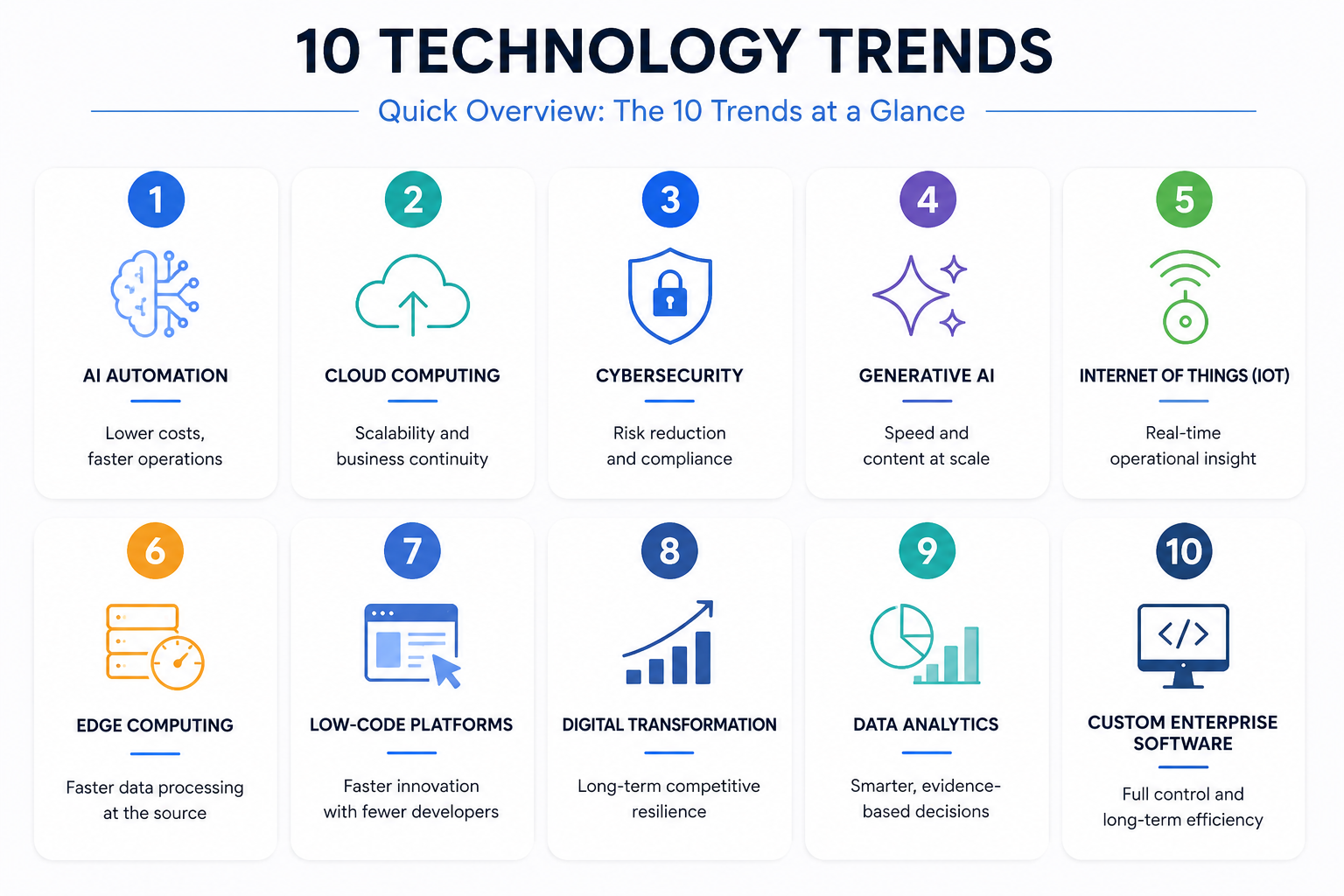
| # | Trend | Core Benefit |
| 1 | AI Automation | Lower costs, faster operations |
| 2 | Cloud Computing | Scalability and business continuity |
| 3 | Cybersecurity | Risk reduction and compliance |
| 4 | Generative AI | Speed and content at scale |
| 5 | Internet of Things (IoT) | Real-time operational insight |
| 6 | Edge Computing | Faster data processing at the source |
| 7 | Low-Code Platforms | Faster innovation with fewer developers |
| 8 | Digital Transformation | Long-term competitive resilience |
| 9 | Data Analytics | Smarter, evidence-based decisions |
| 10 | Custom Enterprise Software | Full control and long-term efficiency |
Artificial intelligence is no longer a tool reserved for large tech companies. In 2026, it is doing real work across finance, HR, customer service, and operations, at companies of every size.
What AI automation handles today:
The business case is direct. Fewer manual errors, faster turnaround, and teams that can focus on higher-value work instead of repetitive tasks.
Leaders who act now gain a compounding advantage. Every process you automate today is a cost you stop paying tomorrow.
The cloud is where modern business infrastructure lives. In 2026, organizations of all sizes rely on cloud platforms to store data, run applications, and scale without massive upfront investment.
Key reasons businesses are deepening cloud commitments:
For leaders planning international growth, cloud platforms remove the barriers that once made expansion slow and expensive. A startup today can access the same computing power as a global enterprise, on the same day.
Ransomware, phishing, and data breaches now cost companies millions, along with something harder to rebuild: trust. A single incident can erase years of reputation.
This is exactly why cybersecurity has moved from the IT department to the boardroom agenda.
What a security-first approach looks like in 2026:
Non-compliance carries financial penalties and public consequences. Investing in strong defenses now is far less expensive than recovering from a breach later.
Generative AI has moved well past the novelty stage. In 2026, it is a practical daily tool used across departments to produce content, write code, summarize documents, and generate ideas faster than any team could manually.
Where generative AI delivers the most value:
| Department | Use Case | Time Saved |
| Marketing | Campaign copy and visuals | Hours to minutes |
| Customer Support | Instant, accurate response drafts | Significant |
| Software Development | Code suggestions and documentation | Meaningful reduction |
| Legal and Compliance | Document summarization | Substantial |
| HR | Job descriptions, policy drafts | Notable |
The leaders who benefit most treat generative AI as a force multiplier, not a replacement for judgment. Clear guidelines, human review, and responsible use turn these tools into a genuine competitive edge.
The Internet of Things links physical devices to digital platforms, and it keeps expanding into industries that once operated entirely offline.
Sensors, smart meters, and connected machines now feed continuous real-time data into business systems. This gives operations teams a clearer, faster view of what is happening on the ground.
Real-world IoT applications in 2026:
The payoff is efficiency and foresight. When your machines and facilities report their own status continuously, you make decisions based on facts instead of guesswork.
As IoT networks grow, sending every piece of data to a central server before acting on it creates unacceptable delays. Edge computing solves this by processing data at or near the point where it is generated.
When edge computing matters most:
Edge computing reduces bandwidth costs, improves response times, and keeps sensitive data local when security or privacy policies require it. In 2026, it is an essential layer in any serious real-time operation.
Not every organization has a large developer team. Demand for software, however, keeps growing. Low-code and no-code platforms bridge this gap by letting non-technical teams build functional applications using visual tools and pre-built components.
How low-code changes the pace of work:
Low-code does not replace expert software development. It extends your team's capacity and brings innovation within reach for people who understand the business problem best.
Digital transformation is not a project. It is not something you complete and then move on from. In 2026, the most resilient organizations treat it as a permanent operating mode.
Customer expectations keep rising. People want fast service, smooth digital experiences, and responses that feel personal. Meeting those expectations requires systems that evolve continuously, not infrastructure that sits unchanged until it breaks.
What continuous transformation looks like in practice:
Organizations that treat transformation as a habit compound their advantage over time. Those that treat it as a one-time initiative fall behind and pay more to catch up.
Every business generates data. In 2026, the difference between high-performing organizations and average ones often comes down to how well they use it.
Advanced analytics tools convert raw numbers into clear, actionable insights. Leaders no longer need to rely on gut feeling when data can show exactly what customers want, where revenue is leaking, and which strategies actually produce results.
The progression from data to decision:
| Stage | What Happens | Business Value |
| Data Collection | Systems capture transactions, behavior, and operations | Foundation for all analysis |
| Data Cleaning | Errors, duplicates, and gaps are removed | Reliable numbers to trust |
| Descriptive Analytics | Historical trends are identified | Understanding of what happened |
| Predictive Analytics | Models forecast future patterns | Early action on emerging risks |
| Prescriptive Analytics | Systems recommend optimal actions | Faster, more confident decisions |
Reliable data is only useful when the systems that hold it are trustworthy. Investing in clean data infrastructure and clear dashboards pays dividends across every business function.
For years, off-the-shelf software was the default choice. It was quick to buy, simple to start, and easy to justify. But as businesses scale, generic platforms increasingly stop fitting the way real work happens.
In 2026, enterprises are returning to custom software, and with good reason.
Custom software vs. off-the-shelf: a direct comparison
| Factor | Off-the-Shelf Software | Custom Software |
| Initial Cost | Lower upfront | Higher upfront investment |
| Long-Term Cost | Recurring licenses plus workarounds | Lower over time, no license dependency |
| Fit to Your Process | Requires adapting your workflows | Built exactly around your workflows |
| Scalability | Limited by vendor's roadmap | Scales precisely with your needs |
| Integration | Often limited or costly to extend | Designed to connect with your systems |
| Data Control | Shared or vendor-managed environments | Full ownership and control |
| Strategic Value | Generic, replicated by competitors | Unique, becomes a business asset |
Custom software is built to match how your business actually operates. There are no unused modules, no forced workarounds, and no dependency on a vendor's update schedule.
For leaders planning three to five years ahead, tailored software is a strategic investment that delivers compounding returns. It is not an expense. It is an asset.
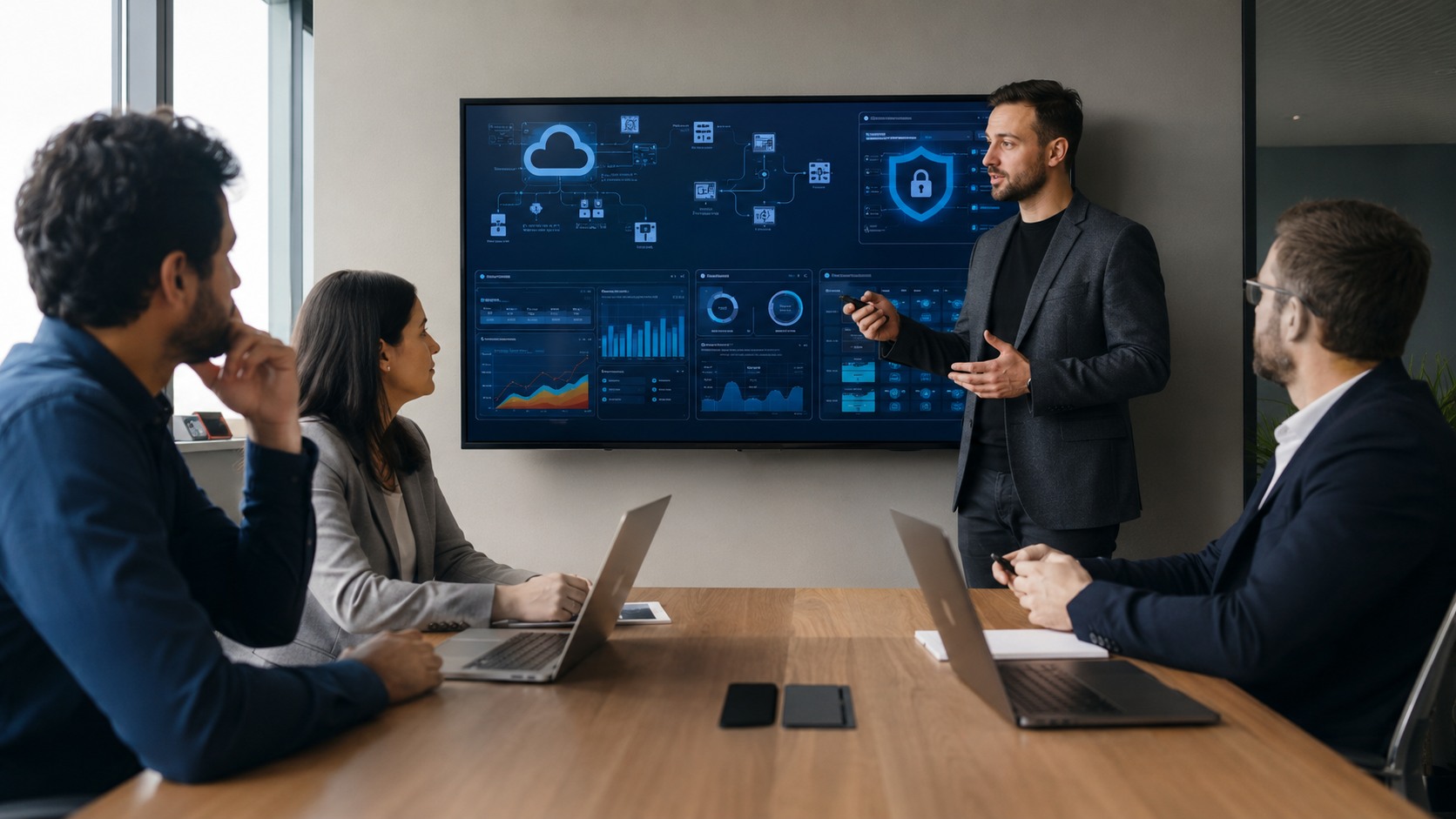
These ten trends share a clear through-line. Each one is about building a business that operates smarter, stays protected, and grows without hitting unnecessary limits.
Here is how they connect:
The businesses that lead in 2026 will not try to adopt every trend at once. They will identify which technologies align with their most important goals, move with purpose, and work with partners who understand both the technology and the business challenge behind it.
That alignment is what turns trends into real, measurable advantage.
At Netro Systems, we work with business leaders to build secure, scalable, and practical digital solutions tailored to real organizational needs. Whether you are modernizing legacy systems, automating key workflows, or building custom software from the ground up, we are ready to deliver.
The future belongs to those who prepare for it. Let us build yours together.
In 2026, the takeaway for business leaders is unmistakable: technology is no longer a support function, it is the business. The convergence of AI automation, advanced analytics, and custom software isn't just about keeping pace; it is about widening the gap between market leaders and everyone else.
Navigating these ten trends doesn't mean adopting all of them at once. It means identifying the specific levers that will unlock the most value for your operation and executing them with precision. The future belongs to organizations that treat digital transformation not as a single milestone, but as a continuous discipline.
1. Does my business need to adopt all 10 trends simultaneously to remain competitive?
No. Trying to implement every trend at once leads to operational fatigue. Focus first on foundational trends that directly impact your immediate bottlenecks—such as AI automation for reducing overhead or cloud computing for scalability—and expand from there.
2. Why should we invest in custom software when off-the-shelf options are cheaper to start?
While off-the-shelf software has lower upfront costs, it often forces you to alter your business processes to fit the vendor's design. Over time, recurring licensing fees and rigid limitations slow down growth. Custom software is built entirely around your specific workflows, provides full data ownership, and scales seamlessly as an appreciative asset for your enterprise.
3. Will generative AI replace the need for human staff in marketing and support?
Generative AI acts as a force multiplier, not a replacement for human judgment. It eliminates hours of routine execution—like drafting basic copy or summarizing documents—allowing your team to focus on high-level strategy, complex problem-solving, and deeper client relationships.
4. Can low-code platforms entirely replace the need for a dedicated development team?
No. Low-code and no-code platforms excel at helping non-technical teams prototype quickly or build simple internal tools. However, complex system integrations, heavy security architectures, and core proprietary software still require expert developers to ensure stability and security.
5. How long does a typical digital transformation take to yield measurable ROI?
Digital transformation is a continuous journey, but initial phases typically yield measurable returns within 3 to 6 months. By prioritizing high-impact, low-complexity workflows for early automation, businesses can fund longer-term modernization efforts using the savings generated upfront.

45 Reviews

45 Reviews